
Most Plano drivers hit a pothole, hear a loud thump, check that their wheel still looks round, and keep driving. What they don’t realize is that the impact just knocked their alignment out of specification, tore a control arm bushing internally, or damaged a ball joint in ways they won’t notice for weeks. Your European vehicle’s sophisticated suspension system doesn’t broadcast every problem with warning lights and loud noises.
At EurAuto Shop, we see the aftermath daily when BMW, Porsche, and Mercedes owners finally notice their steering wheel sitting crooked or their tires wearing on one edge. In this article, we’ll walk you through the hidden damage potholes cause, the timeline of how symptoms develop, and why specialized diagnostics matter for catching problems before they cascade into multiple failures.
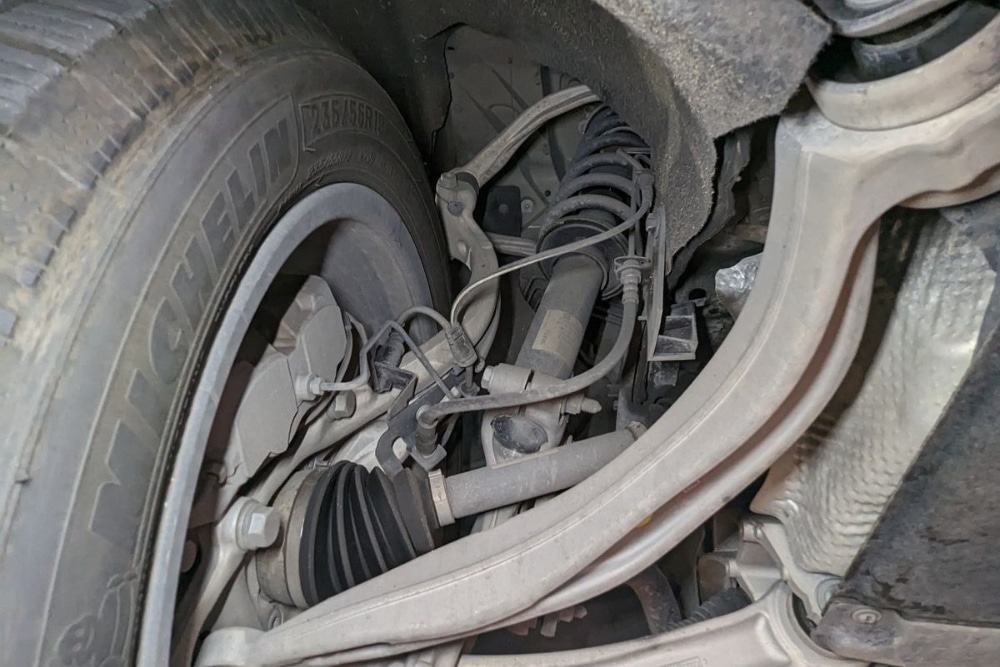
The Hidden Impact: What North Texas Potholes Do to Your Suspension
That jarring thud you feel when your wheel drops into a pothole isn’t just uncomfortable. It’s a violent impact that sends shockwaves through your entire suspension system. Your tire compresses, the wheel takes the force, and everything connected to it absorbs trauma in milliseconds.
European vehicles like BMW, Porsche, and Mercedes feature sophisticated suspension designs with precise tolerances. These systems deliver the performance and handling you expect, but they’re also more sensitive to impact damage than basic vehicle suspensions.
What absorbs the impact:
- Tires and wheels: First point of contact, taking the initial force
- Control arms and bushings: Metal arms with rubber cushions connecting wheels to the frame
- Ball joints and tie rods: Pivot points allowing steering and suspension movement
- Struts and shock absorbers: Damping units controlling compression and rebound
- Springs and stabilizer bars: Components managing weight transfer and body roll
The real problem? Most damage happens internally, where you can’t see it. A bushing tears inside its housing. A ball joint develops microscopic play. An alignment angle shifts by half a degree. None of these screams for attention, but all affect how your vehicle drives.
The Timeline of Deterioration: How Damage Progresses
Understanding how pothole damage evolves helps you catch problems before they become dangerous.
Week 1 - The Silent Phase
Your vehicle might feel slightly different, but nothing alarming. The steering wheel could sit a fraction off-center. Most drivers adapt and keep driving.
Weeks 2-4 - Subtle Changes Appear
The steering pull becomes more noticeable. You’re making constant micro-corrections on straight roads. Tire noise might increase slightly. New sounds appear over bumps.
Months 2-3 - Obvious Symptoms Develop
Now you’re certain something’s wrong. The vehicle drifts noticeably. Your tires show uneven wear patterns. Handling in corners feels less confident.
Months 4+ - Cascading Failures Begin
One damaged component accelerates wear on others. That torn bushing allows excessive movement, which stresses the ball joint. The misalignment wears through the tire tread. What started as a single problem becomes multiple repairs.
This progression explains why early detection matters. Catching damage in Week 1 might require one alignment adjustment. Waiting until Month 4 could mean replacing multiple suspension components plus a new set of tires.
Warning Signs Plano Drivers Need to Recognize After Pothole Strikes
Your European vehicle communicates problems through specific symptoms. Learning this language helps you identify issues before they worsen.
Steering behavior changes:
- Wheel pulls left or right on level roads
- The steering wheel sits crooked when driving straight
- Increased effort is needed to turn
- Delayed response when you turn the wheel
- Wandering feel requiring constant corrections
Handling and ride quality indicators:
- Excessive body roll in corners
- Bouncing or floating sensation over bumps
- Harsh impacts from small road irregularities
- The vehicle feels loose or disconnected
- Reduced stability at highway speeds
Audible warnings:
- Clunking over bumps or when turning
- Creaking during suspension compression
- Knocking from the front end
- Rattling from underneath the vehicle
Tire evidence:
- One edge is wearing faster than the other
- Cupping or scalloping around the circumference
- Feathered tread blocks feel smooth one way and sharp the other
- Abnormal tire noise or vibration
Suspension Damage vs. Alignment Issues: Understanding the Difference
| Aspect | Alignment Issues | Suspension Damage |
|---|---|---|
| Primary Cause | Impact knocks angles out of specification | Components are physically damaged or worn |
| Main Symptoms | Pulling, crooked steering wheel, tire wear | Noises, loose feel, poor handling, bouncing |
| Progression Speed | Remains constant until corrected | Continues worsening over time |
| Tire Impact | Uneven wear in specific patterns | Can cause irregular wear and vibration |
| Repair Approach | Adjustment using alignment equipment | Component replacement required |
| Can Drive Safely | Short-term, yes, but accelerates tire wear | Potentially dangerous depending on severity |
Both issues often exist together after a pothole strikes. An impact might bend a control arm and knock alignment out simultaneously. This is why comprehensive diagnostics matter. Addressing only the alignment without fixing damaged components means the problem returns quickly.
Why European Vehicles Require Specialized Suspension Care in Plano
Your BMW’s multi-link rear suspension uses different geometry than standard vehicles. The adaptive damping system in your Land Rover adjusts in milliseconds based on road conditions. Your Porsche’s suspension setup is calibrated for precise handling characteristics that define the driving experience.
These sophisticated systems demand specialized knowledge and equipment for proper suspension repair. Generic repair shops often lack the tools and expertise needed to properly diagnose and repair European suspension systems.
What specialized suspension repair requires:
- Factory scan tools: Communicate with vehicle control modules for accurate diagnostics
- Manufacturer specifications: Alignment procedures and tolerances specific to each European brand
- Engineering expertise: Understanding component relationships in multi-link and adaptive systems
- Quality replacement parts: OEM or equivalent parts designed for your specific vehicle
- Brand experience: Familiarity with BMW, Porsche, Mercedes, and Land Rover suspension architectures
At EurAuto Shop, our team includes BMW Master Technicians, a Porsche Certified Technician, and ASE Master certification, ensuring expert-level service for these systems. We use factory scan tools, including iScan and Autologic software designed for European vehicles. This expertise allows us to diagnose problems other shops might miss and complete suspension repair correctly the first time, preventing recurring issues that waste your time and money.
Expert Suspension Diagnostics at Our West Plano Parkway Facility
Identifying pothole damage requires systematic evaluation. Our comprehensive suspension inspection includes:
Visual inspection stage:
- Examining all suspension components for visible damage
- Checking for torn or separated bushings
- Looking for bent or deformed control arms
- Inspecting shock absorbers for fluid leaks
- Verifying spring condition and ride height
Measurement and testing:
- Precision alignment check, measuring all angles
- Testing for excessive play in ball joints
- Checking the tie rod end condition and tightness
- Evaluating wheel bearing condition
- Measuring tire wear patterns and remaining tread depth
Road test evaluation:
- Assessing steering response and centering
- Noting any pulling or drift tendencies
- Listening for unusual noises over various road surfaces
- Evaluating handling through corners
Transparent Communication Throughout the Process
We complete thorough digital vehicle inspections with photo documentation, then review findings with you before recommending any services. This transparency reflects our commitment to treating every client like family. We follow an open-door policy throughout this process. You’re welcome to observe your vehicle being inspected and ask questions. No hidden recommendations or pressure. Just honest assessments from certified technicians who understand European suspension systems.
Protecting Your Investment: Prevention Strategies for Richardson and Frisco Drivers
While you can’t avoid every pothole on North Texas roads, you can minimize damage and catch problems early.
Defensive driving strategies:
- Scan the road ahead for potential hazards
- Reduce speed when you spot potholes
- Avoid sudden swerving that could be more dangerous than the impact
- Leave a following distance that gives you time to react
- Be extra cautious after rain when potholes fill with water
Maintenance practices that help:
- Check tire pressure monthly and maintain manufacturer specifications
- Rotate tires according to recommended intervals
- Inspect tires regularly for damage and uneven wear
- Schedule suspension inspections after the winter pothole season
- Address any handling changes immediately rather than waiting
FAQs About Pothole Damage and Suspension Problems
Can potholes damage suspension even without noise?
Yes, potholes can cause significant suspension damage without producing any noise. Internal component damage like torn bushings, bent control arms, or weakened shock absorbers often develops silently but affects handling and alignment over time.
What suspension parts fail after winter?
Control arm bushings, ball joints, tie rod ends, shock absorbers, and struts commonly fail after winter pothole damage. These components absorb impact forces and can develop cracks, excessive play, or loss of damping capability that affects vehicle handling and safety.
Do potholes affect wheel alignment?
Potholes frequently knock wheel alignment out of specification by shifting suspension angles. Even small alignment changes cause uneven tire wear, steering pull, and handling problems that worsen over time without correction.
How can suspension damage be diagnosed?
Suspension damage is diagnosed through visual inspection of components, alignment measurement, road testing, and checking for excessive play in joints. Professional technicians use specialized equipment to identify damage that isn’t visible during casual inspection.
Where can suspension repairs be done in Plano, TX?
Suspension repairs for European vehicles can be done at EurAuto Shop in Plano, where certified technicians use factory scan tools and specialized equipment. The facility serves Plano, Richardson, Frisco, McKinney, and surrounding Collin County areas with expertise in BMW, Porsche, Mercedes, Jaguar, Land Rover, and Audi suspension systems.
Book Your Suspension Inspection at EurAuto Shop in Plano
When suspension or alignment problems develop, our facility serves drivers throughout Plano, Richardson, Frisco, McKinney, Carrollton, Addison, and all of Collin County with specialized care for BMW, Porsche, Mercedes, Jaguar, Land Rover, and Audi vehicles.
We back our work with a lifetime warranty on parts and labor for non-wear items, plus a 5-year/50,000-mile warranty on wearable components. These warranties reflect our confidence in the quality repairs performed by our certified team. We also provide complimentary Uber and Lyft service for your convenience during service visits.
If you’ve noticed any handling changes, steering concerns, or tire wear developing on your European vehicle, don’t wait for the problem to worsen. Visit EurAuto Shop at 4008 West Plano Parkway, Plano, TX 75093, or call 214-552-4194 to schedule your suspension inspection. Let us help you protect your investment and restore the precise handling your vehicle was built to deliver.